




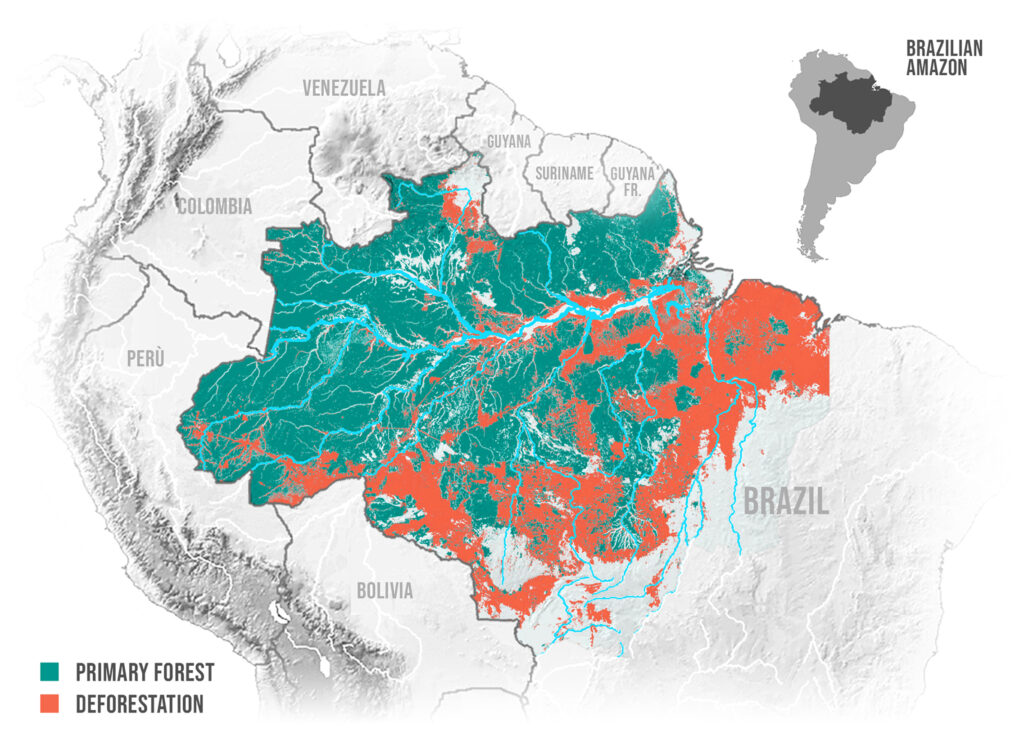


















WHERE WE ARE

WHY THE AMAZON?

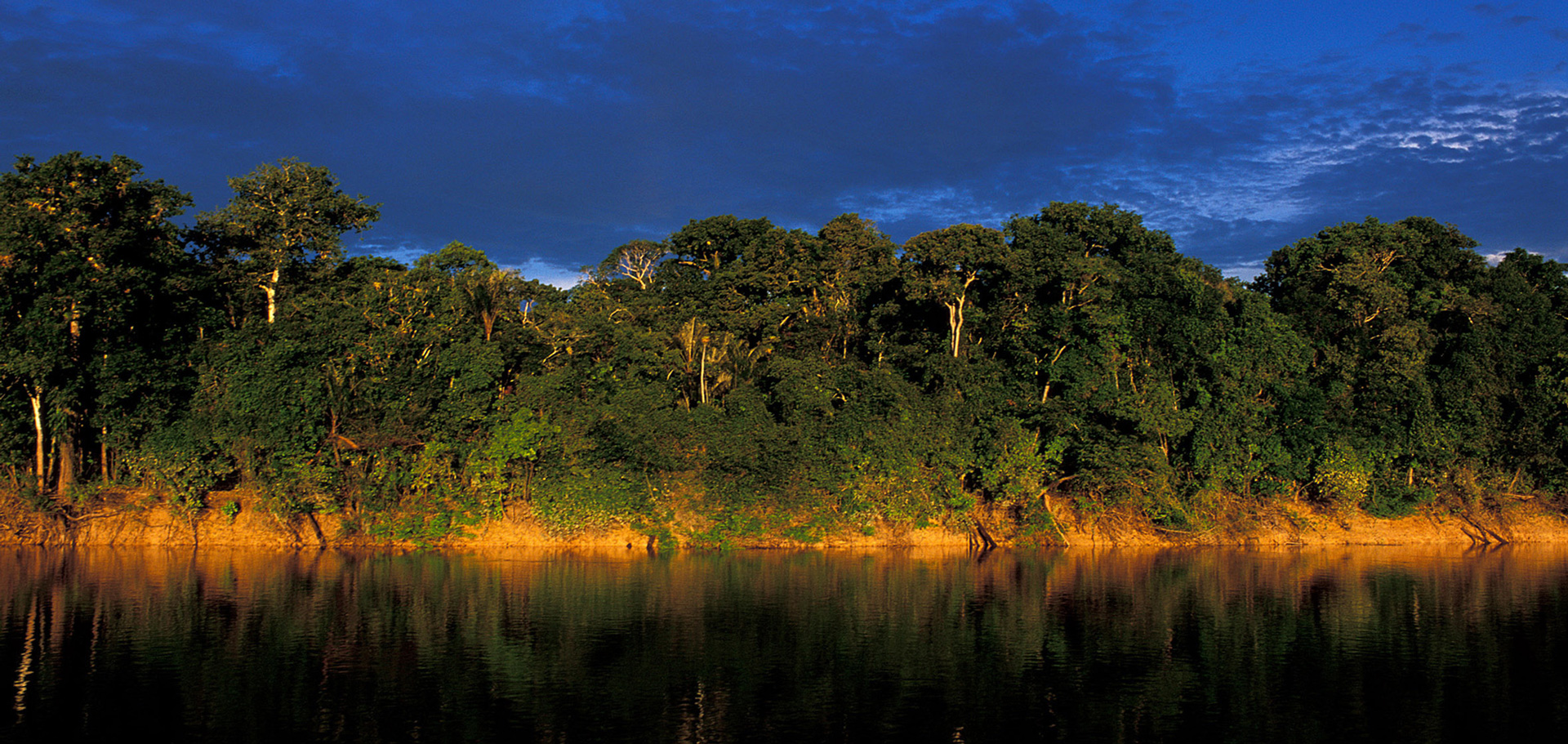
The forest of the Amazon River basin is central to life on Earth

It is a powerful ally in the fight against climate change.
It’s unique, and it is threatened. 

foresta
0 million
km2
The largest rainforest in the world
fiume
0 000
m3/s
The river that carries the most water in the world
specieAnimali_02
0 %
of all known species lives here!
A unique biodiversity, still unknown.
indigeni_02
0 million
people living there
Indigenous peoples, traditional communities: a precious cultural diversity
in the world, this year

hectares of forests cut or burned globally

Data processed by The World Counts

Facts

Good News

Half of the planet’s rainforests have already disappeared. The Amazon remains the largest on the planet. 

The good news is that 80% of it is still standing, making our challenge possible.

About us

20 YEARS IN THE FIELD

Our commitment is the long-term protection of the Amazon, its forest and its diversity

We operate in areas of intact forest, in the heart of the Brazilian Amazon.
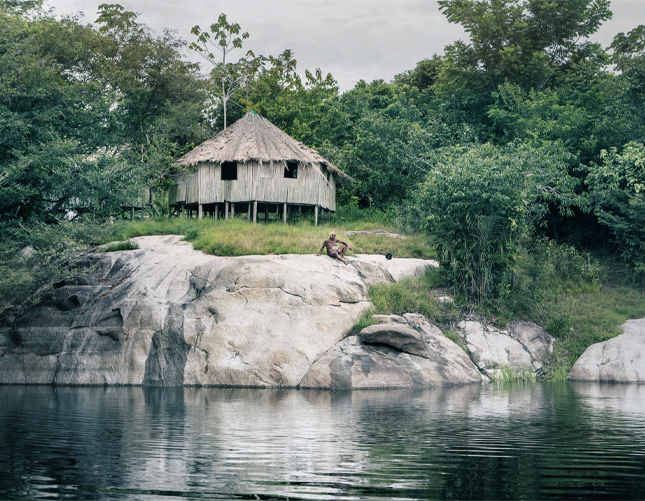
We support the native people, the forest  guardians, to defend their environment, culture and traditions. As we spread their word.

what we do

WE PROTECT OUR FOREST

2018

Jauaperi EXTRACTIVE Reserve

600,000 hectares of untouched forest, plucked from deforestation and protected forever

In 2018, together with the native population of the Rio Jauaperi, a tributary of the Rio Negro, one of the main tributaries of the Amazon, we achieved the creation of an important protected area, with an extension more than half the size of Jamaica.

600,000 hectares of untouched forest, plucked from deforestation and long-term protected, learn more about the Jauaperi Extractive Reserve. 

COMMON GOALS

WE CHANGE THE WORLD, WITH SMALL ACTIONS

Our interventions follow the path indicated by the UN Sustainable Development Goals. We participate in the global challenge for a fairer world, a healthier planet and a less uncertain future.

Our partners

Endorsements

WHAT WE CAN DO TOGETHER

it's TIME TO TAKE ACTION. AND WE OFFER YOU THE OPPORTUNITY TO DO IT

We are the opportunity you were looking for. Join us to contribute to the battle in defence of the Amazon and its peoples, counter the climate crisis, guarantee the health of our planet and offer humanity a future.

DONATE NOW

Battles need funds.
Make a donation and you will be with us every day, actively, in the field.

Partecipate

Battles need people.
Invest your time, your skills and your passion. 

COME VISIT US

The most beautiful battlefield.
Experience the Amazon and get to know its guardians.

Companies

Are you a company or a foundation? Find out how to become greener with our projects.

DONATE NOW

Battles need funds.
Make a donation and you will be with us every day, actively, in the field.

COME VISIT US

Battles need people.
Experience the Amazon and get to know its guardians.

Companies

Are you a company or a foundation? Find out how to become greener with our projects.

and more...

Protect a tree

Celebrate a special occasion by giving long life to a tree in the Amazon rainforest.

You will receive a Personalized Certificate with the dedication you want, the photo and the geographical coordinates of the tree you have chosen to protect.

from our blog.

Articles from our blog

Another school completed in the forest

The new Xixuaú primary school is ready to welcome the upcoming school year, which is about to begin in Brazil.

Twice the size of the previous building, the Teodorico Nascimento School, named after the founder of the village, was designed to meet the needs of a growing community. The school includes two classrooms—one for preschool children and one for students from first to fifth grade—a library, a spacious kitchen with a dining area, restrooms, storage rooms, and access to filtered water, making it a true point of reference for children and families.

Fully powered by solar energy, the school was built through the collective efforts of the community and the operational work of CoopXixuaú, in collaboration with ICMBio, the Municipality of Rorainópolis, and our partner Amazon Charitable Trust.


This is a concrete step toward strengthening education in Jauaperi Reserve, supporting families in remaining in their territory, valuing traditional ways of life, and protecting the forest.

With thanks to Riccio Giramondo, Fondazione Adiuvare, Trentino Insieme (Rothooblass), 3B Meteo, Elettra srl, Fondazione Quarta de Matteis, Margherita Pantano, and the Associazione dei Carabinieri di Lanuvio.

Click to learn more about our education projects.


COP30 in Belém: when the climate enters the forest 

More than 50,000 people gathered for ten days in Belém, the capital of the state of Pará, at the gateway to the Amazon. 

One of the most significant features of COP30 was the unprecedented participation of civil society and Indigenous and traditional peoples. Thousands of people from Pan-Amazonia and other regions of the world took part in the negotiations, side events, and mobilizations. Among them was Emanuela Evangelista, biologist and president of Amazônia ETS, who attended together with a group of representatives from the Jauaperi national park. 

“This was the highest level of inclusion of Indigenous and community representatives in the history of the COPs,” Evangelista emphasized. “They brought visions and solutions based on nature and ancestral knowledge, showing that there are different ways of inhabiting the planet.” 

Peaceful demonstrations, marches, and parallel summits had a tangible impact: among the outcomes was the protection of new Indigenous territories. The Belém COP demonstrated that when forest peoples’ voices are given space, they can make a difference.

Amazônia in the Blue Zone: 25 years of field experience 

Within this context, Amazônia ETS actively participated in COP30. The organization spoke at two official events in the Blue Zone. The first, on November 10 at the Italy Pavilion, titled “Amazonia: strategies and best practices to avoid collapse a 25-year experience,” offered a dialogue between Europe and Brazil on concrete solutions for forest conservation. Alongside Evangelista, speakers included Jonas da Rosa Gonçalves of the Amazon Charitable Trust and Alda Brazão, an Indigenous leader from the Baniwa people and representative of the community cooperative CoopXixuaú. 

The second event, on November 17, was the international side event “An insider’s blueprint: a lifetime of proven climate actions on the ground,” co-organized with the Amazon Charitable Trust. The meeting explored the role of scientific and community collaborations in strengthening local capacity and promoting a just transition rooted in traditional knowledge. 

“Climate justice and ecological justice today urgently demand the defense of forests,” Evangelista stated. “Avoiding the point of no return in the Amazon means zero deforestation and reforestation. In both cases, forest peoples know how to do it. It is up to us to listen to them.”

Results and limits of COP30 

From a negotiation standpoint, COP30 did not deliver a shared global roadmap for phasing out fossil fuels, but it did mark some progress. An agreement was reached to triple climate adaptation funds by 2035, and, above all, the most comprehensive global mapping to date emerged of countries willing to move away definitively from fossil fuels. 

“A roadmap to accelerate the transition is now necessary and inevitable,” Evangelista explained. “We would have liked a more ambitious outcome, but the processes that have been launched will continue to shape the international debate in the coming months.” 

On deforestation, serious critical issues remain. The final document acknowledges the urgency of halting and reversing forest loss by 2030, but without defining a global action plan. Meanwhile, the Amazon continues to lose billions of trees every year and to suffer increasingly frequent extreme climate events.

A collective process, a global mutirão 

The final text of COP30 was titled Global Mutirão, evoking a deeply Amazonian concept: the collective action required when an individual cannot succeed alone. It is a powerful metaphor for the climate challenge. 

“Global climate action is a collective movement,” Evangelista concluded. “It advances even in the absence of a few denialist actors; it grows in the streets and in negotiations, in science and in ancestral knowledge. And, like a mutirão, it requires everyone to row in the same direction.” 

COP30 in Belém was a milestone, not a conclusion. But bringing the world into the heart of the Amazon made one truth increasingly impossible to ignore: without the forest and without those who inhabit it, there is no credible solution to the climate crisis. 

São Raimundo Casa de Farinha inaugurated: food security, bioeconomy and income for rural communities 

On the margins of the Brazilian Amazon, the state of Maranhão is a crucial transition territory, where development pressures make environmental and social balances particularly fragile.

On November 6, 2025, the São Raimundo Casa de Farinha was inaugurated in the community of Vila São Jorge, in Cidelândia, Maranhão. This new community-based agro-industry is dedicated to processing cassava, a staple food for millions of people and a cornerstone of food security in Amazonian rural communities. 

The initiative is a new milestone of the project “Together We Plant the Future”, which we have been carrying out since 2023 in partnership with the Instituto Brasileiro de Desenvolvimento e Sustentabilidade (IABS) and in collaboration with local organizations. 

The facility was created to generate income, strengthen the cassava value chain and improve working conditions for family farmers. It is collectively managed by the Associação dos Pequenos Produtores Rurais do Projeto de Assentamento São Jorge (ASPRAJORGE) and represents a concrete step toward more equitable and sustainable territorial development. 

Equipped with modern machinery, water reuse systems, waste treatment solutions and features designed to improve thermal comfort, the Casa de Farinha can produce up to one ton of flour per day, with an estimated annual output of around 260 tons. In doing so, it enhances traditional knowledge deeply rooted in the territory. 

Promoting the leadership of local communities through sustainable solutions that generate income and strengthen the bioeconomy is a core pillar of the “Together We Plant the Future” project. The Casa de Farinha stands as a tangible symbol of territorial development, capable of transforming traditional knowledge into a collective enterprise with positive social and environmental impact. “The strengthening of institutional capacity is reflected in the ongoing training processes that have enabled the Agrovila São Jorge Association to manage the enterprise effectively. The collective management model — with a Management Committee and a Technical Committee — ensures democratic decision-making and actively engages the community in the day-to-day operation of the business,” says Carolina Sales, the project’s Operational Coordinator.


The local community also highlights the immediate benefits. “Now we can produce more, with less effort and under much better conditions,” says Reginaldo Marques de Sousa, a producer and long-standing reference for flour production in the area. The project improves not only efficiency, but also the quality of life of the families involved. 

The São Raimundo Casa de Farinha is part of a broader project strategy active in nine municipalities across Maranhão and Pará, with the support of Sofidel and Suzano. By connecting fragmented and isolated forest áreas, the initiative will help create a major biodiversity corridor, promoting ecological connectivity across 2,210 square kilometers of rainforest. 

A project that shows how local development, environmental protection and social justice can move forward together—starting from communities and from the value of the land they inhabit. 

Watch the inauguration video (in Portuguese).

COP 30 in Belém: A “Global Mutirão” in the Amazon

The 2025 United Nations Climate Change Conference, COP 30, will take place from November 10–21 in Belém, in the heart of the Brazilian Amazon. The location is symbolic and historic: for the first time, a COP will be held in one of the planet’s most critical ecosystems, placing the Amazon rainforest at the centre of the global climate debate.

Around 40,000–50,000 delegates, observers, and participants are expected to attend, representing virtually all 198 Parties to the UNFCCC. Among them will be roughly 3,000 Indigenous representatives, about 1,000 of whom will participate directly in negotiations within the Blue Zone.

These numbers underscore the scale and significance of COP 30: not only a diplomatic conference, but a broad, inclusive, and hands-on global mobilization.

 Priorities of the COP 30 Presidency

The conference will be led by André Corrêa do Lago, who has outlined a clear vision: a more concrete and participatory COP. The guiding idea is the concept of a “Global Mutirão” — a large collective effort bringing together governments, civil society, businesses, and local communities for real-world climate action.

Key priorities include:

  • shifting from commitment to tangible action, turning the Paris Agreement goals into concrete policies and projects;
  • putting people at the centre, valuing local knowledge and community-based initiatives, especially in the Amazon;
  • strengthening multilateral cooperation and linking global negotiations with real results on the ground.


President Letters and the Conference Pillars

To date, the presidency has issued several official letters describing the vision and roadmap for COP 30,each emphasizing the Mutirão approach to working together.They identify four main pillars:global mobilization; implementation; formal negotiations;and a leaders’ summit.The stated goal is to ensure these elements move in synergy, delivering visible outcomesstarting in 2025.

What Makes COP 30 Different

COP 30 is being called theCOP of implementation: rather than focusing only on newpledges, it aims to advance delivery on commitments already made, especially after the2023 Global Stocktake.Holding the event in the Amazon has powerful symbolic and political significance: it bringsthe climate discussion directly into one of the world’s most vital ecological regions

Amazônia ETS and the Italian Contribution

Amazônia ETS will participate in COP 30, represented by its president Emanuela Evangelista.

“The future of the forest depends on our ability to join forces with local communities — its true guardians,” Evangelista stated. “I call this the COP of the Amazons, to highlight the plurality of local realities. We expect one of the largest social mobilizations in COP history,with strong participation from forest peoples. Indigenous communities, traditional  populations, and urban movements have been preparing for a long time, and their voices must be heard and understood.”

Amazônia ETS will join two official events:

November 10 at 3:30 PM — at the Italian Pavilion:

“Amazon: strategies and best practices to prevent collapse—a 25-year experience” with international and community partners

November 17 at 6:30 PM — side event:

“Amplifying the voices of youth, women, and Indigenous peoples: initiatives for fair climate justice”, co-organized with Amazon Charitable Trust

Evangelista adds:

“We hope to move the focus beyond deforestation — not only in the Amazon — toward nature-based solutions, and that the unique setting of this COP will foster more ambitious negotiations and stronger commitments.”

With these initiatives, Amazônia ETS reaffirms its mission to build bridges between Europe and the Amazon, promoting concrete solutions for environmental conservation and climate justice.

Associazione Amazonia Milano ETS
Registered office:
Via Pola 21 – 20124 Milan, Italy
C.F. 97389380151 – P Iva 13129030964

Sign up for our Newsletter

Join us. And stay informed.

Our newsletter is occasional. From time to time, just like with friends, we tell you what happens in our forest!


Connect With Us

© 2025 – All rights reserved.

designed by VisiOnAir | development by EI | Icons by Made x Made